How to Choose the Best Cloud PACS Workflow Orchestration: 2026 Buyer's Guide
Your radiology team loses minutes on every study to routing, storage, and sharing steps that should be automatic. Cloud PACS workflow orchestration decides whether those minutes compound into delays or disappear into a single connected pipeline.
This guide walks through what Medicai offers, the criteria that separate strong orchestration platforms from weak ones, and how pricing, compliance, and AI-supported workflows factor into the decision. By the end, you will know whether Medicai fits your imaging operation or whether another path makes more sense for 2026.
What Is Medicai and What Does It Do?
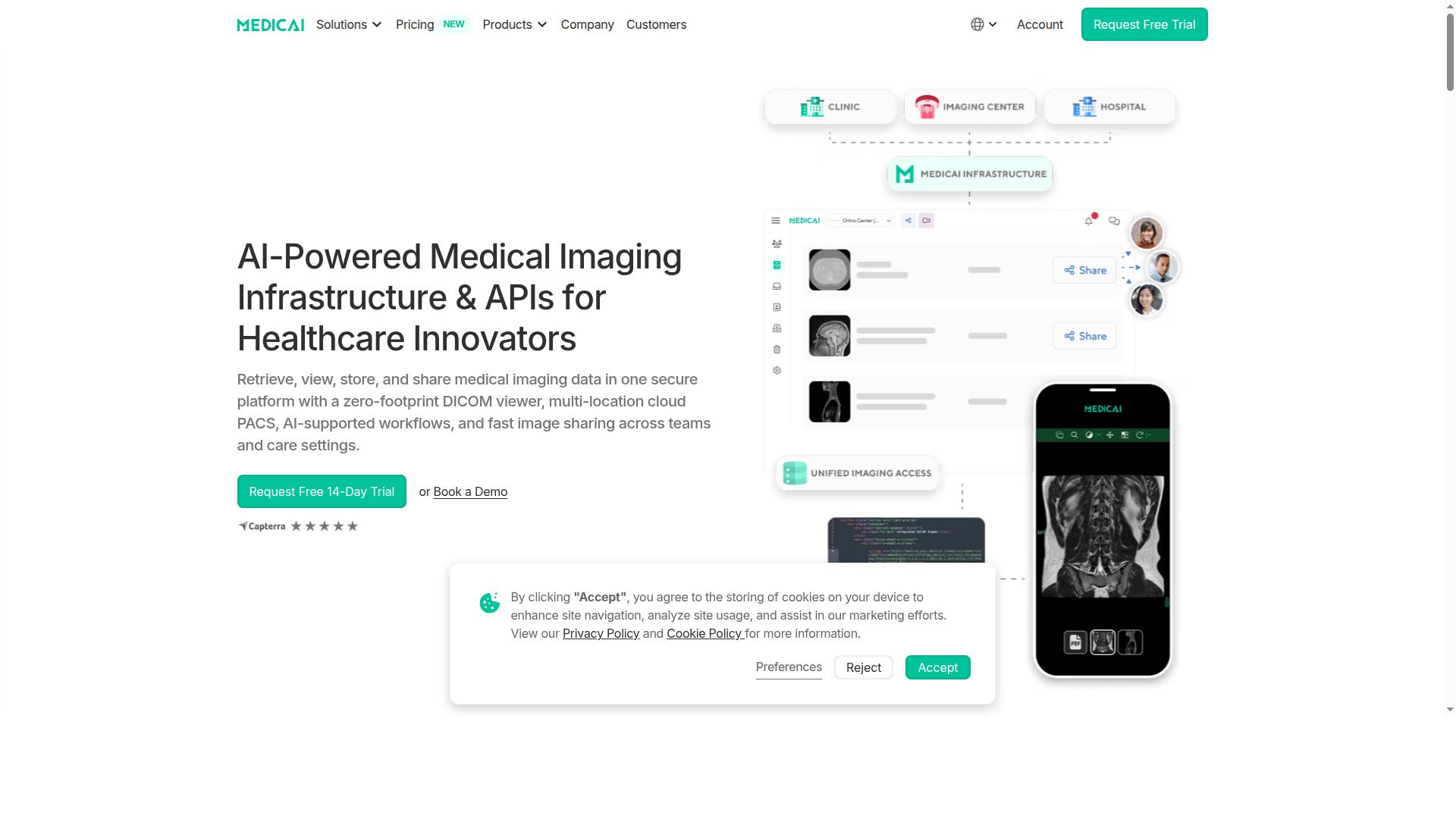
Medicai is a cloud-based medical imaging platform that enables healthcare providers to retrieve, view, store, and share medical imaging data in one secure platform with a zero-footprint DICOM viewer. It is delivered as SaaS, which means imaging teams access core functions through a browser rather than maintaining heavy on-site infrastructure.
The platform is best understood as Imaging Infrastructure as a Service (IIaaS). Medicai is a VC-backed healthcare startup focused on modernizing medical imaging workflows and enabling interoperability across care settings.
For buyers evaluating cloud PACS workflow orchestration in 2026, that positioning matters. Medicai sits at the center of medical imaging operations, connecting storage, viewing, and exchange instead of treating them as separate systems.
Four capabilities define what the platform does:
- Cloud PACS: a multi-location picture archiving and communication system that keeps imaging data accessible across sites and teams.
- Zero-footprint DICOM viewer: image review in the browser, with no local software installation.
- Image sharing: fast exchange of imaging data across teams and care settings.
- Vendor-neutral archive: a standards-based store of imaging data that is not tied to a single equipment vendor.
Medicai also supports AI-supported workflows, an area radiology informatics teams increasingly weigh when planning workflow orchestration. Combined with the vendor-neutral archive, this gives providers a foundation for interoperability rather than a closed imaging silo.
Compliance and clearance are central to any buyer's shortlist. Medicai is HIPAA and GDPR compliant and FDA/CEE cleared, which addresses the two questions most procurement teams ask first: is patient data protected, and is the platform cleared for clinical use?
Medicai supports healthcare providers globally. For organizations comparing cloud-native architecture options, that combination of compliance, clearance, and multi-location cloud PACS makes Medicai a credible candidate for the imaging backbone of a modern workflow orchestration strategy.
Why Medicai Is a Strong Choice for Cloud PACS Workflow Orchestration in 2026
As healthcare imaging demands grow in 2026, Medicai's cloud-native architecture and proven track record make it a compelling option for workflow orchestration. Imaging data volumes keep climbing, and radiology teams increasingly expect interoperability across DICOM, HL7, and FHIR systems rather than isolated archives.
Medicai serves 70 clinics and hospitals with more than 10,000 active doctors on the platform, a footprint that speaks to real production use rather than pilot projects. Its HIPAA and GDPR compliance, FDA/CEE cleared viewers, and Microsoft Azure partnership round out the picture for buyers weighing risk.
The details below show how Medicai maps to the core criteria in this 2026 buyer's guide.
How Medicai Addresses the Core Buyer Criteria
Medicai addresses core buyer criteria by providing a cloud-native platform with demonstrated scalability, interoperability, and reliability. The evidence is concrete: 1M+ studies transacted or processed per year, 50M+ yearly API transactions, and 1.7M+ studies in storage.
That volume matters because workflow orchestration lives or dies on throughput. Image routing, prefetching, and worklist management all generate API calls and data movement, and a platform handling tens of millions of transactions has shown it can carry that load. More than 2M+ imaging studies uploaded to date reinforces the operational scale.
Interoperability is central to the design. Medicai works with DICOM and web standards for viewing, and its zero-footprint and diagnostic viewers support access without local installation. Buyers evaluating vendors should confirm DICOM conformance and HL7 or FHIR integration paths against their own radiology informatics stack, and Medicai's cloud-native foundation is built for that connected model.
Reliability and security are addressed through HIPAA and GDPR compliance, OWASP security guidelines, and a Microsoft Azure partnership that underpins high availability expectations. FDA/CEE cleared viewers add a regulatory dimension many cloud PACS options lack.
Performance shows up in outcomes too. Medicai reports reducing diagnosis time by 65%, and 300k+ DICOM study visualizations in the last year point to active clinical use.
For data migration and legacy PACS transitions, buyers should plan carefully, and Medicai's cloud-native model supports phased moves from on-premises or hybrid environments. The platform's press coverage, including global multidisciplinary tumor boards and access to cancer treatment for Ukrainian refugee patients, shows orchestration working across borders. On balance, Medicai meets the 2026 criteria with verifiable operating numbers and a clear compliance posture.
Key Features That Set Medicai Apart
Medicai distinguishes itself through a comprehensive set of features designed to streamline imaging workflows from acquisition to interpretation. Rather than stitching together separate tools for connectivity, storage, and viewing, the platform groups these capabilities into three connected feature categories.
The sections below break them down: connectivity and retrieval, storage and management, and access and visualization. Together, these features are built to enhance workflow orchestration across a medical imaging organization, from the moment a study arrives to the point of diagnosis and sharing.
For a buyer comparing Cloud PACS options in 2026, understanding how these categories work together matters more than any single checkbox. Each one is covered in detail next.
Connect, Retrieve, Store, and Share in One Platform
Medicai integrates connectivity, storage, and sharing into a single platform, eliminating the need for disparate systems. The journey starts with the Medical Imaging Uploader and DICOM Gateway, which connect modalities and bring studies into the platform.
From there, images are held in Cloud PACS or a Vendor Neutral Archive, giving teams a durable, standards-based home for imaging data. Sharing happens through the Medical Image Exchange and the Medical Image Sharing Platform, so referring clinicians and partners can receive studies without friction.
Two supporting capabilities round out the workflow:
- Patient Case Management keeps cases organized across the care journey.
- Backup and Disaster Recovery protects continuity if systems fail.
The practical benefit is reduced complexity. Instead of maintaining separate connections, archives, and exchange tools, radiology informatics teams work from one platform. That unified approach supports cleaner image routing and fewer handoffs, which is exactly what buyers should look for when scoring workflow orchestration.
It also simplifies data migration planning. When connectivity, storage, and sharing live together, moving off a legacy PACS involves fewer moving parts and less risk of gaps between systems.
AI-Supported Workflows and Structured Reporting
Medicai enhances workflow orchestration with AI-supported tools and structured reporting capabilities that streamline interpretation and communication. The platform's AI layer is built through partnerships, including MD.ai and Rayscape.ai, alongside a Radiology AI Co-Pilot and AI-Powered Diagnostics.
These tools are aimed at the parts of radiology that consume the most time: triage, detection, and the communication of findings. AI support can reduce manual effort in the reading workflow, while structured reporting turns impressions into standardized, actionable output that referring teams can act on.
The platform also supports Teleradiology and Tumor Boards, both of which depend on fast, clear exchange of imaging and findings between distributed specialists. In practice, this means the same study that arrives through the DICOM Gateway can move through AI-assisted review, structured documentation, and multi-disciplinary discussion without leaving the environment.
For a 2026 buyer, the takeaway is that AI and reporting should be judged as workflow features, not standalone novelties. Medicai's approach ties them into the broader orchestration layer, so the value shows up in fewer manual steps and more consistent communication across the care team.
Pricing and Plans
Medicai offers transparent monthly pricing with two plans: Starter at $249/month and Standard at $749/month, catering to different storage and connectivity needs. A third Enterprise tier is available at custom pricing for organizations with more complex infrastructure.
What stands out in this structure is that user accounts are unlimited on every tier. Buyers evaluating Cloud PACS workflow orchestration in 2026 should weigh that carefully, because many vendors tie seat counts to cost.
| Plan | Monthly Price | Yearly Billing (15% savings) | Cloud Storage | User Accounts | Connected Locations |
|---|---|---|---|---|---|
| Starter | $249/month | $209/month paid yearly | 500 GB | Unlimited | None |
| Standard | $749/month | $639/month paid yearly | 2 TB | Unlimited | One |
| Enterprise | Custom | Custom | Custom | Unlimited | Multiple connected and external locations |
The Starter plan suits a single-site practice or a reading group that needs cloud storage and a diagnostic viewer without site-to-site connectivity. Its 500 GB ceiling fits modest imaging volumes, and the lack of connected locations keeps the setup simple.
The Standard plan adds 2 TB of storage and one connected location, which matters for imaging routing between a main site and a remote reading point. For a growing practice, that single connection often covers the most common DICOM routing need.
Pricing scales along two dimensions: storage volume and connected locations. Moving from Starter to Standard roughly quadruples storage and adds one site connection. Organizations needing multiple connected and external locations move to Enterprise, where storage and pricing are scoped to the deployment.
One cost to budget for separately is the DICOM Gateway Setup at $1,000 one-time per location. Buyers should include this in first-year totals when comparing quotes, since gateway configuration underpins image routing and interoperability across sites.
Two more terms shape the real cost. Yearly billing saves 15%, which lowers Starter to $209/month and Standard to $639/month. A free 14-day trial of Starter features is available with no credit card required, so teams can evaluate the viewer and workflow before committing.
Enterprise customers can also access per-study pricing, which helps high-volume or variable-volume imaging operations align spend with actual throughput. Note that refunds are not available for partial periods, so contract length deserves attention.
For a small practice, Starter delivers the clearest value: unlimited users, 500 GB of storage, and a predictable monthly figure. Larger practices with multiple sites should compare Standard plus gateway setup against an Enterprise quote, since the location count drives the decision more than storage alone.
As a vendor-neutral cloud platform, Medicai keeps these tiers legible for radiology informatics teams planning scalability and business continuity. The pricing model is straightforward, and the 15% yearly saving rewards longer commitments.
Trust Signals: Compliance, Track Record, and Testimonials
Medicai demonstrates trust through compliance with HIPAA and GDPR, FDA clearance, and a track record of processing over 1 million studies annually. For a buyer evaluating cloud PACS workflow orchestration in 2026, these signals matter as much as any feature list. A platform handling medical imaging must prove it can protect patient data, meet regulatory obligations, and sustain volume without faltering.
Trust in this category is not a single badge on a marketing page. It is the combination of certifications, regulatory clearances, and measurable operational history that shows a vendor can be relied on for clinical work. The points below outline what Medicai brings to that evaluation.
Compliance and security posture. Medicai is HIPAA and GDPR compliant, and it follows OWASP security guidelines. Those frameworks cover protected health information handling, data residency expectations for European and US clients, and common web application risks. For a radiology informatics buyer, this combination addresses the two most common due diligence questions: can the vendor safeguard patient data, and does it follow recognized security practice?
Regulatory clearance. FDA/CEE Cleared Viewers are available on the platform. Clearance matters because diagnostic viewing sits at the center of clinical decision-making, and buyers should confirm that any diagnostic viewer they deploy carries the appropriate regulatory status for their market.
Operational track record. Volume tells a story that certificates cannot. Medicai's platform has handled:
- 1M+ studies transacted or processed per year
- 1.7M+ studies in storage
- 2M+ imaging studies uploaded in total
- 300k+ visualizations of DICOM studies in the last year
- 50M+ yearly API transactions
These figures point to sustained throughput across DICOM storage, retrieval, and integration traffic. High API transaction counts are especially relevant for buyers planning HL7 and FHIR integrations or auto-routing between systems. A vendor with this level of activity has handled real production load, not just pilot deployments.
Adoption and ecosystem validation. Medicai reports 70 clinics and hospitals on the platform and 10,000+ active doctors using it. Its partnership with Microsoft Azure adds infrastructure-level validation, since running medical imaging workloads on a major cloud provider supports the scalability and high availability expectations buyers set in a 2026 buyer's guide. The platform has also been featured in press for enabling global multidisciplinary tumor boards and for helping Ukrainian refugee patients access cancer treatments.
Measured clinical impact. Medicai reports reducing diagnosis time by 65%. For workflow orchestration decisions, that figure speaks directly to the outcomes buyers care about: faster image routing, quicker worklist turnaround, and less time lost between acquisition and reading.
How to weigh these signals in your evaluation. Use the following checklist when comparing any vendor's trust claims:
- Confirm compliance certifications apply to your jurisdiction and data types.
- Verify regulatory clearance for any diagnostic viewer you intend to use clinically.
- Ask for volume metrics that reflect production use, such as studies processed and API transactions.
- Check whether cloud infrastructure partners are named and verifiable.
- Look for documented clinical impact rather than generic efficiency claims.
On every one of these points, Medicai provides concrete, checkable evidence rather than vague assurances. Compliance is certified, viewers are cleared, and the operational numbers reflect years of real imaging activity across clinics, hospitals, and thousands of doctors. For buyers building a shortlist for cloud PACS workflow orchestration, that record makes Medicai a credible and well-supported choice.
Who Should Use Medicai
Medicai is designed for healthcare providers of all sizes, from hospitals and imaging centers to specialty practices like orthopedics, neurology, and oncology. Its cloud PACS and workflow orchestration platform serves organizations that need to manage medical imaging across multiple locations, teams, and systems without the overhead of maintaining on-premises infrastructure.
The platform is available globally, which matters for buyers evaluating interoperability and cross-border imaging workflows. Whether a practice operates in a single region or coordinates care across sites, the same cloud-native foundation supports the work.
Below is a breakdown of the main audiences Medicai serves and the specific needs each one brings to a Cloud PACS decision.
Hospitals typically run complex, multi-department imaging operations where workflow orchestration has to connect radiology, cardiology, and other service lines. Medicai supports this through DICOM, HL7, FHIR, and IHE profiles, which are the standards that matter when a hospital needs its picture archiving and communication system to talk to existing EHRs and departmental systems. For hospitals weighing a vendor-neutral archive strategy, that standards coverage is a core selection criterion.
Imaging centers and teleradiology services depend on throughput and image routing. Medicai's target audience includes these groups because they need worklist management, auto-routing, and load balancing to keep studies moving to the right readers. Growing imaging volumes put pressure on scalability, and a cloud-native architecture gives these organizations room to expand without a hardware refresh cycle.
Specialty care providers often have narrower but deeper imaging needs. Medicai lists orthopedics, neurology, oncology, radiology, cardiology, ophthalmology, ob-gyn, pulmonology, dentistry, and gastroenterology among the practices it serves. For these groups, the value lies in a diagnostic viewer and zero-footprint viewer that fit specialty reading patterns.
Several adjacent audiences also fit the platform's scope:
- Virtual care providers and telemedicine platforms that need imaging accessible outside a physical facility
- Personal injury lawyers who review imaging as part of case work
- Tumor boards and clinical trials that require coordinated review across specialists
- Medical education organizations that use imaging for teaching
- Patients, who are served through the Patient Portal
For multi-site practices, interoperability is the deciding factor. Medicai's support for DICOM, HL7, FHIR, and IHE profiles helps organizations connect disparate systems and route images across locations. That matters when a practice grows through acquisition or adds a new site and needs a unified workflow rather than a patchwork of local archives.
For organizations facing rising study volumes, scalability and high availability are the priorities. A cloud-native foundation supports elastic capacity, while multi-tenancy lets a single platform serve multiple facilities or departments. Buyers should still confirm uptime SLA terms, latency expectations, and disaster recovery commitments during evaluation.
Finally, organizations moving off a legacy PACS should plan for data migration and consider an on-premises hybrid approach where needed. Medicai's fit depends on whether its standards coverage and cloud model match the buyer's continuity requirements. The platform is available globally, so geography is rarely the limiting factor.
Verdict: Medicai is a credible choice for hospitals, imaging centers, specialty practices, teleradiology services, and the other provider types it names. If your organization needs standards-based interoperability, scalable cloud infrastructure, and a viewer that works across sites, it belongs on your 2026 shortlist.
Final Verdict: Is Medicai the Best Fit for Your Workflow Orchestration Needs?
Medicai stands out as a robust cloud PACS solution for workflow orchestration, but the best fit depends on your specific requirements and scale. For imaging teams that want a cloud-native platform rather than a patched-together set of point tools, the case is strong. The platform is built to handle the core orchestration jobs that matter most in medical imaging.
Its main strengths cluster around integration and flexibility. Medicai supports interoperability standards such as DICOM, HL7, and FHIR, which matters when a picture archiving and communication system has to talk to modalities, RIS, EHRs, and analytics tools. That standards-first approach reduces friction during data migration and when connecting a vendor-neutral archive.
The platform also brings AI support and a zero-footprint viewer into the same environment, so radiology informatics teams can extend workflows without bolting on separate systems. For organizations weighing a move off legacy PACS or an on-premises hybrid setup, a single cloud-native architecture simplifies image routing, worklist management, and prefetching decisions.
No platform is the right answer for every buyer. Pricing and contract structure should be weighed against your expected throughput, latency needs, and uptime SLA expectations. Teams with highly specialized hanging protocol requirements or deep custom integrations should confirm those needs are covered before committing.
Use this simple decision framework to guide the call:
- Choose Medicai if you need an integrated, cloud-native platform with strong interoperability and AI support in one place.
- Prioritize a demo if your workflow depends on specific DICOM, HL7, or FHIR interfaces that must be validated against your existing systems.
- Ask about scale and continuity if high availability, disaster recovery, and business continuity are board-level concerns.
- Revisit pricing if budget certainty across multi-year terms is a deciding factor for your organization.
The clearest next step is a personalized assessment. Medicai can map your current image routing, worklist, and archive workflows against its platform so you can see where orchestration improves and where gaps remain. That conversation is far more useful than a generic feature comparison.
You can reach the team directly to start that assessment:
- Medicai USA: 7901 4th St N, STE 300, St. Petersburg, FL, 33702. Phone: +1 (832) 220 1035
- Medicai Romania: 53-55 N Filipescu, 5th Floor, Sector 2, Bucharest, 020961. Phone: +40 316 305 875
- Email: sales@medicai.org
For most imaging organizations evaluating a 2026 cloud PACS decision, Medicai is a credible, well-positioned choice. Confirm the fit against your own workflow, and the verdict becomes clear.
Frequently Asked Questions
What exactly does "cloud PACS workflow orchestration" mean, and why does it matter in 2026?
Cloud PACS workflow orchestration is the layer that coordinates how imaging studies move between modalities, storage, viewers, and the people who need them - replacing manual handoffs with automated routing, retrieval, and sharing. It matters because radiology and specialty teams are judged on turnaround time and access, not just storage capacity. A platform like Medicai combines retrieval (DICOM Gateway, Medical Imaging Uploader), storage (Cloud PACS, Vendor Neutral Archive), and a zero-footprint DICOM viewer in one secure environment, so orchestration happens in a single platform rather than across disconnected tools.
How should we evaluate security and compliance when shortlisting vendors?
Start by confirming which regulatory frameworks the vendor supports and whether those claims are documented, not just marketed. Medicai is HIPAA and GDPR compliant and offers FDA/CEE-cleared viewers, which covers the baseline most healthcare providers need. Ask every shortlisted vendor for evidence of compliance posture and secure development practices - for example, Medicai follows OWASP secure practices - and confirm how data is protected across multi-location cloud environments.
Do we need to replace our existing PACS to adopt a cloud orchestration platform?
Not necessarily. Many organizations layer a cloud platform on top of existing systems to handle retrieval, exchange, and collaboration without ripping out their on-premise PACS. Medicai's DICOM Gateway and Medical Image Exchange are designed to connect and move imaging data, while its Vendor Neutral Archive provides a standards-based store for long-term management. Map your current infrastructure first, then ask vendors to show how their orchestration fits around it rather than forcing a full replacement.
How can we estimate cost before committing, and what pricing models are typical?
Ask for pricing tied to storage volume and connected locations, since those are the variables that usually drive cost in cloud PACS. Medicai publishes transparent monthly tiers - Starter at $249/month (500 GB storage, unlimited users, no connected locations), Standard at $749/month (2 TB storage, unlimited users, one connected location), and custom Enterprise pricing - which makes early budgeting easier. For competitors, request written quotes against your own study volumes rather than relying on list prices, and model growth over 2-3 years.
What proof of real-world scale and reliability should a buyer demand?
Ask vendors for evidence of production volume and reliability, not just feature lists. Medicai reports 1M+ studies transacted or processed per year, 1.7M+ studies in storage, 300k+ DICOM study visualizations in the last year, and 50M+ yearly API transactions - concrete indicators of operational scale. Also ask about backup and disaster recovery; Medicai offers Backup and Disaster Recovery as part of its platform, which is essential for continuity planning.
How do we assess integrations, viewing, and collaboration capabilities?
Check that the platform supports the standards your systems rely on (DICOM, and where relevant HL7/FHIR), and confirm how images are viewed and shared with referrers and patients. Medicai provides a zero-footprint DICOM viewer, Patient Case Management, and Medical Image Exchange for collaboration across locations. Its partnership ecosystem - including Microsoft Azure, Amazon AWS, OHIF, MedDream, and MD.ai - is also worth reviewing to see whether the integrations you need are already supported.