TaskRio vs Tasks.Bot for Workflow Automation Software
Your team already lives in WhatsApp, yet tasks still get lost in chat threads. Choosing the wrong workflow automation tool means paying for a platform your field crew will not open. This comparison looks at two options built around very different assumptions.
By the end, you will know how Tasks.Bot automates task creation, approvals, and reminders inside WhatsApp, how it stacks up against TaskRio on features and pricing, and which teams should pick which tool. You will also see the trust signals behind each platform, so you can decide with facts instead of demos.
What Is Tasks.Bot? Who It's Built For
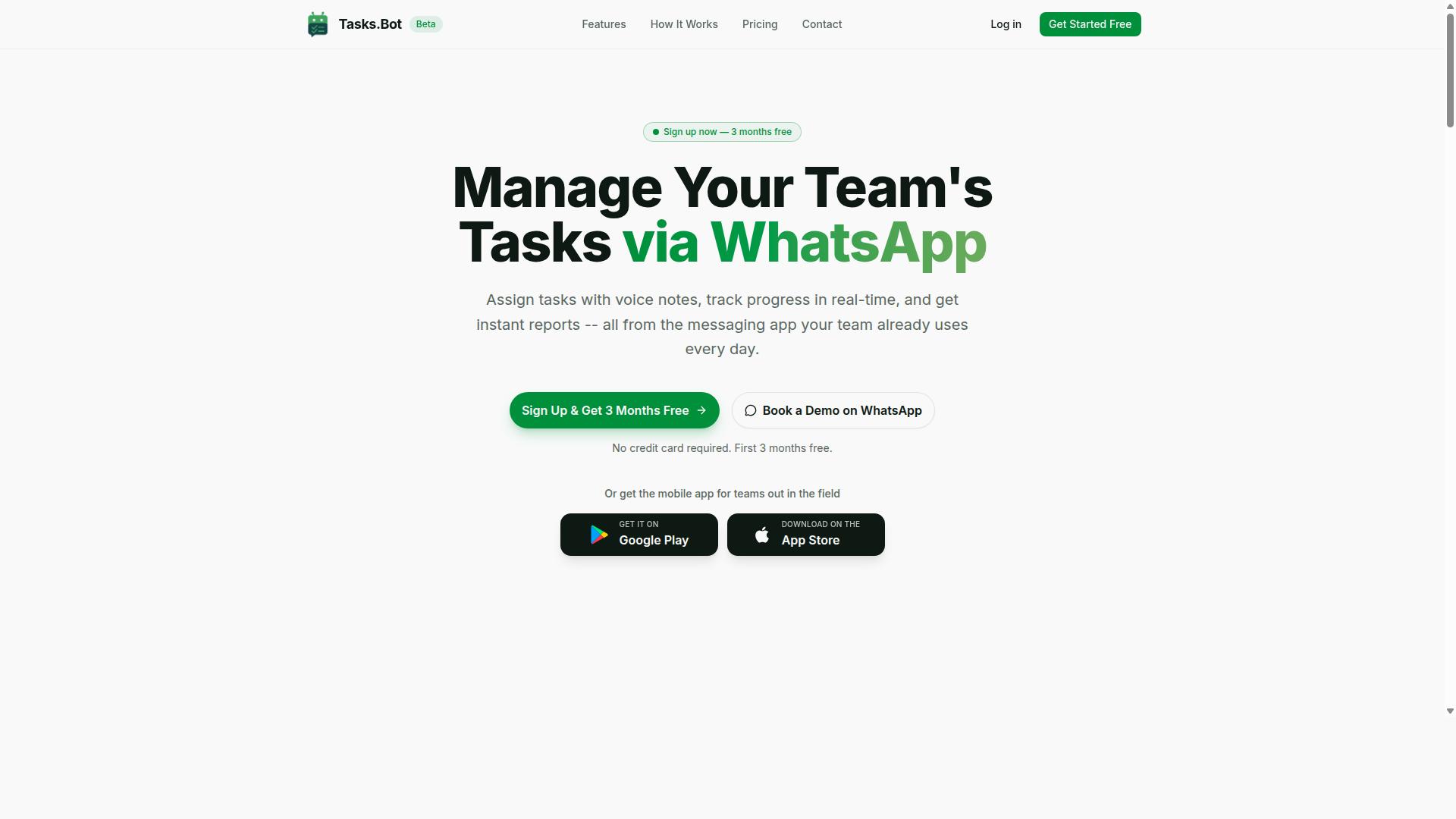
Tasks.Bot is a task management platform that operates entirely within WhatsApp, enabling teams to assign tasks, track progress, and receive reports without leaving the messaging app. It is a cloud-based SaaS product built around a simple idea: most field and frontline teams already live in WhatsApp, so the workflow should come to them rather than forcing them onto yet another dashboard.
That design choice shapes who the platform is built for. Tasks.Bot suits teams that already run day-to-day communication through WhatsApp, particularly those with field staff who need structured task management, attendance tracking, and payroll-ready hours in one place.
Typical users include operations managers coordinating remote crews, supervisors assigning jobs across multiple sites, and small businesses that want business process automation without a heavy rollout. A mobile app for field teams is also part of the product, so workers can capture tasks, voice notes, and updates on the move while admins keep oversight in the chat.
Tasks.Bot is currently in beta and used by hundreds of teams. It also offers a free trial period, which gives new users a low-risk way to see whether WhatsApp-based task management fits how their team already works.
How Tasks.Bot Automates Workflows Inside WhatsApp
Tasks.Bot leverages the ubiquity of WhatsApp to automate task-related workflows, allowing users to create tasks via voice notes, receive smart deadline reminders, and trigger approvals and automations within the chat interface.
The core mechanisms are straightforward. Team members can create tasks using natural language, and the platform uses AI to understand user intent and turn a message into a structured task. Voice note task creation means a supervisor walking a site can speak a job into existence instead of typing it out later.
From there, several automation layers keep work moving:
- Automatic task assignment, so the right person gets the job without manual routing
- Smart deadline reminders
- Approvals and automations
- Instant reports generated from task activity
One of the strongest advantages is what team members do not need to do. No new app installation or account creation is required for them, because everything happens in WhatsApp. That removes the onboarding friction that usually kills adoption of a new productivity tool.
A field team might use this daily in a simple loop. A manager sends a voice note about a site inspection. Tasks.Bot creates the task, assigns it, and reminds the assigned worker as the deadline nears. When the worker marks it complete, an approval request can fire automatically, and an instant report lands back in the chat.
Tasks can also be tracked on a mobile app for field teams, with tasks on a map, a live day tracker, and face-verified attendance. Shifts, leave, and hours management round out the same workflow, so the hours captured in the field are ready for payroll. For teams weighing workflow automation software, that combination of native WhatsApp integration and a dedicated field app is what separates Tasks.Bot from tools that expect everyone to log into a separate system.
TaskRio vs Tasks.Bot: The Core Difference in Workflow Automation
The fundamental difference between TaskRio and Tasks.Bot lies in their approach to workflow automation: TaskRio is a traditional no-code/low-code automation platform, while Tasks.Bot is a task management tool that operates natively within WhatsApp, focusing on team collaboration and field operations.
That distinction shapes everything about how each product is used. TaskRio asks teams to think like builders. Tasks.Bot asks teams to think like workers. The first is about connecting systems. The second is about getting tasks done.
Understanding this split helps you pick the right tool for your business process automation needs, rather than forcing one philosophy onto a problem it was never designed to solve.
TaskRio follows the classic no-code automation model. Users build automation workflows inside a visual builder, then connect the apps they already rely on. A trigger in one tool fires an action in another, and conditional logic decides what happens next.
This is the same family as Zapier, Make, n8n, and Microsoft Power Automate. The value comes from integration platform thinking: one system talks to another without a developer writing code. API connectivity and complicated processes do the heavy lifting.
Tasks.Bot takes a different route. It is built for task management inside WhatsApp, with automation embedded directly in the task lifecycle. Team members do not install anything or create new accounts. The work happens where conversations already happen.
The practical result is a much shorter path from "task assigned" to "task completed."
Adoption friction is where the two tools diverge most sharply. A traditional workflow automation platform often assumes every participant will log into a dashboard, learn a builder, and check a separate app for updates. That is reasonable for operations staff. It is a harder sell for field teams.
Tasks.Bot removes that step entirely. Because it runs inside WhatsApp, there is no new interface to learn and no second inbox to monitor. AI understands natural language and voice notes for task creation, so a team member can log work the way they already send a message.
For field staff management, the difference is concrete. Tasks.Bot includes face-verified attendance and live GPS tracking, which matters when you need to confirm who showed up and where they were. Enterprise-grade encryption protects the data, and conversations and task data are never shared or used for training.
Teams can evaluate all of this through a 3-month free trial with no credit card required.
Neither tool wins outright. They solve different problems, and the right answer depends on what you are actually trying to automate.
- Choose TaskRio-style automation when the goal is complex, multi-app orchestration across CRM, billing, marketing, and internal databases. This is business process automation at the systems level, closer in spirit to robotic process automation than to daily task tracking.
- Choose Tasks.Bot when the goal is team coordination and field staff management, where the bottleneck is people not seeing, accepting, or finishing assigned work.
- Watch for overlap if you need both. Some organizations run a no-code automation platform for back-office plumbing and a WhatsApp-native task tool for the frontline.
Scalability, pricing plans, and subscription models also reflect the split. Traditional platforms often price per task, per workflow run, or per connected app. Task tools typically price around seats and usage. Compare total cost against the work you actually need done, not against feature counts.
For most teams weighing workflow automation software for coordination-heavy work, Tasks.Bot is the more direct fit. It meets teams in WhatsApp, requires no separate app, and ties automation to the task itself rather than to a builder canvas.
TaskRio remains a strong option for integration-heavy, multi-app scenarios. But when the real problem is task assignment, follow-through, and field visibility, a purpose-built WhatsApp task manager closes the gap faster than any diagram of connected apps.
Key Workflow Automation Features Compared
When comparing TaskRio and Tasks.Bot, it's essential to evaluate how each handles core workflow automation features such as task creation, assignment, approvals, reminders, and reporting. These are the capabilities that shape how quickly work moves from a request to a completed job, especially for teams that operate away from a desk.
This comparison focuses on practical capabilities that impact daily team productivity, not marketing checklists. The goal is to show where each platform fits naturally into a team's existing habits and where friction tends to appear.
Both platforms aim to automate workflows, but they approach the problem with different strengths. TaskRio centers on a traditional task management experience inside its own platform, while Tasks.Bot builds its workflow automation around native WhatsApp integration, so tasks, approvals, and reports live where many teams already communicate.
The sections below break the comparison into two areas: how tasks are created, assigned, and approved, and how deadlines, reporting, and field team tracking are handled. Together, these cover the workflow automation features that matter most for day-to-day execution.
Task Creation, Assignment, and Approvals
Tasks.Bot simplifies task creation by allowing users to send voice notes or natural language messages in WhatsApp, which are automatically converted into tasks and assigned to the right team members. The platform uses AI to understand user intent and create tasks from messages, so a manager does not need to open a separate dashboard or fill out a form.
Assignment can be rule-based or manual. A field manager could send a voice note such as "Assign John to inspect site A by Friday," and Tasks.Bot creates the task, assigns it, and sets a deadline in one step. That single message replaces the usual sequence of opening an app, choosing a project, selecting an assignee, and entering a due date.
Approvals follow the same principle. Approvals can be requested and granted through WhatsApp messages, so a purchase request, leave application, or job sign-off does not stall while someone waits to log into a system. This matters for business process automation because approval delays are often the quietest bottleneck in a workflow.
TaskRio's approach generally involves form-based task creation and assignment within its own platform. That structure suits teams who prefer a centralized project management workspace with defined fields and views. The trade-off is friction: every task, update, and approval requires someone to open the tool, which is harder for field staff or workers who are not at a computer.
Tasks.Bot's method reduces that friction because it uses a tool team members already have on their phones. For distributed teams, that difference in daily effort often decides whether a workflow automation system is actually used or quietly abandoned.
Deadline Reminders, Reports, and Field Team Tracking
Tasks.Bot excels in keeping field teams on track with smart deadline reminders, instant reports generated within WhatsApp, and mobile app-based tracking for attendance and payroll-ready hours.
Reporting is equally direct. Instant reports on task status, completion rates, and team performance are accessible through WhatsApp, so a supervisor can check progress without opening a dashboard or exporting a spreadsheet. The Android and iOS apps add push notifications, voice capture, and a home screen widget for quick updates on the move.
For field teams, Tasks.Bot includes tasks on a map, a live day tracker, face-verified attendance, and shifts, leave, and hours management. Location tracking is available when enabled, and logged hours can feed directly into payroll calculations. These features target the gap between knowing a task was assigned and proving it was completed on site.
TaskRio may offer comparable reminders and reporting, but these typically require logging into a separate dashboard. That works well for office-based teams with desktop access, yet it creates a real barrier for field workers who rely on a phone.
Because Tasks.Bot runs inside WhatsApp, its reminders, reports, and tracking stay accessible to the people doing the work, not just the people managing it. For teams weighing workflow automation software for remote or field-based operations, that accessibility is often the deciding factor.
Pricing and Plans: Tasks.Bot vs TaskRio
Tasks.Bot offers a straightforward pricing model with a single Full Access plan, available in both Indian Rupees and US Dollars, while TaskRio's pricing may vary based on features and user count.
That single-plan approach removes a common frustration in workflow automation software. Instead of comparing tiers to find which one unlocks a needed capability, buyers get everything in one package. The site presents a Select currency option, so the displayed rates should be verified before purchase.
| Plan | Price | What It Covers |
|---|---|---|
| Monthly | ₹200 per member per month | All features included |
| Annual | ₹1,200 per year per member | All features included, 50% savings |
The annual plan works out to a 50% discount compared with paying month to month, saving ₹1,200 per year for each member. For teams weighing per-user pricing, that gap matters when headcount grows. A five-person team on annual billing pays a predictable yearly figure rather than a monthly total that shifts with every hire.
New users also get 3 months free, with no credit card required and the option to cancel anytime. That lowers the risk of evaluating the platform before committing budget.
All features sit inside the Full Access plan, and a refund policy applies. Because nothing is gated behind higher tiers, cost forecasting stays simple: member count multiplied by the listed rate. Tasks.Bot is currently in beta, which may mean special considerations for early adopters, so it is worth confirming current terms directly.
TaskRio's pricing is not specified here. Readers comparing the two should check TaskRio's website for current plans, since its costs may scale with features and user count. That variability makes side-by-side budgeting harder, whereas Tasks.Bot's per-member structure keeps total spend easy to estimate before a team commits.
Trust Signals and Track Record
Tasks.Bot, though currently in beta, has already been adopted by hundreds of teams and offers trust signals such as face-verified check-ins for field staff and a refund policy, indicating a focus on reliability and accountability.
Those signals matter because workflow automation software often touches sensitive parts of a business. Task assignment, team collaboration, and reporting all depend on the platform being dependable. A tool that adds accountability for field staff shows the product was built with real operational needs in mind.
The face-verified check-in feature is a strong trust signal for teams managing remote or field workers. It gives managers a clearer record of who was actually on site, which supports payroll accuracy and client reporting. That kind of verification is not common in lightweight productivity tools.
Tasks.Bot also integrates with WhatsApp, a platform trusted by billions of users worldwide. This adds an inherent layer of trust, since teams already know the interface and the security expectations around it. The site even includes a "Book a Demo on WhatsApp" option, which keeps the first conversation on familiar ground.
A refund policy in the site footer is another straightforward signal. It tells potential buyers the team is willing to stand behind the product. Combined with adoption by hundreds of teams, these points suggest Tasks.Bot takes reliability seriously, even at this stage.
Being in beta is worth acknowledging honestly. It means the platform is still evolving, and some features may change. It also means the team is actively improving the product rather than leaving it static. For early adopters, that can be an advantage if they want influence over where the tool goes next.
For TaskRio, specific trust signals are harder to confirm from public information. Readers comparing the two should do their own checks before committing. Look for:
- Published case studies with named customers
- User reviews on independent software directories
- The overall maturity of the platform and how long it has been available
- Clear documentation of security and data handling practices
Platform maturity is a useful indicator. A longer track record usually means more edge cases have been handled. A newer product may move faster but carry more uncertainty. Neither is automatically better, but the trade-off should be understood before a decision.
One practical step is to ask both vendors for references from teams of a similar size and industry. A vendor confident in its track record will usually provide them. This is especially relevant for business process automation, where downtime or data gaps can affect daily operations.
It also helps to test the tools against your own workflows rather than relying on demos alone. Trigger-based actions, conditional logic, and complicated processes can behave differently once real data is involved. A short trial with a live process reveals more than a feature list.
Overall, Tasks.Bot presents a credible set of trust signals for a product still in beta. Adoption by hundreds of teams, face-verified check-ins, a refund policy, and WhatsApp integration all point to a team focused on accountability and ease of use. The beta label is a fair caveat, not a red flag. For teams weighing workflow automation software, Tasks.Bot is a legitimate option worth evaluating alongside TaskRio, provided both are checked against the same practical criteria.
Who Should Choose Tasks.Bot for Workflow Automation
Tasks.Bot is ideal for teams that rely heavily on WhatsApp for communication, especially those with field staff who need to manage tasks, track attendance, and generate payroll-ready hours without adopting a new app. That single sentence captures the core audience: people who already live in WhatsApp all day and do not want another login, another dashboard, or another training session.
The platform serves hundreds of teams today, and the pattern is consistent. These are organizations where work happens away from a desk, where a supervisor needs to assign a job quickly, and where someone in an office needs a clean record of who did what and for how long.
If your team fits one of the profiles below, Tasks.Bot is likely the stronger fit among workflow automation software options.
- Small to medium-sized businesses with field teams. Construction crews, delivery operations, maintenance and repair services, and similar operations where staff move between sites.
- Remote teams already using WhatsApp. Groups that coordinate through chat today and want structure without leaving that environment.
- Organizations that value simplicity and low adoption friction. Teams where a new tool rollout would stall because nobody has time to learn it.
Consider a construction company with site supervisors. A supervisor can assign work, confirm attendance, and log hours through the messaging app the crew already checks every morning. No app install, no forgotten password, no separate attendance device.
Now consider a delivery startup with drivers on the road. Drivers report status and hours from their phones, and the office gets payroll-ready records instead of a pile of screenshots and voice notes.
Tasks.Bot is global and accessible anywhere WhatsApp is available, so geography is rarely a barrier. The same setup works for a crew in one city or a distributed team across several time zones.
There is a point where a different tool makes more sense. If a team needs complex, multi-app automations with extensive integrations, TaskRio may be the better choice. Teams building trigger-based actions across many systems, or wiring together a no-code automation stack with tools like Zapier, Make, n8n, or Microsoft Power Automate, are solving a different problem.
That kind of work leans toward an integration platform or low-code platform mindset, sometimes touching robotic process automation and API connectivity. It rewards teams with technical staff and clearly mapped business process automation goals.
The distinction is simple. If the priority is task management and team coordination within a familiar messaging environment, Tasks.Bot is the better choice. If the priority is orchestrating data across a dozen disconnected systems, a broader automation platform will serve you better.
Many teams need the first thing and assume they need the second. They buy a sprawling automation suite, spend weeks mapping complicated processes, and still struggle to get a driver to confirm a shift. The tool was never the bottleneck. Adoption was.
Tasks.Bot wins on adoption because it removes the biggest obstacle: learning something new. Your team opens the app they already use, and the work gets tracked.
For field-heavy, chat-first organizations, that combination of task assignment, attendance tracking, and payroll-ready hours inside WhatsApp is the practical answer. It is a cloud-based SaaS product with no on-premise deployment to manage, which keeps the operational burden low for lean teams.
The verdict is clear. If your people are on WhatsApp and your work happens in the field, Tasks.Bot is built for you.
Final Verdict: Is Tasks.Bot the Better Workflow Automation Choice?
The choice between Tasks.Bot and TaskRio ultimately depends on your team's specific needs: Tasks.Bot shines for teams seeking seamless task management within WhatsApp, while TaskRio may be preferable for those requiring complex, cross-platform automation.
Tasks.Bot builds its workflow automation software around a channel your team already uses every day. Instead of asking people to adopt another dashboard, it handles task management inside WhatsApp, which lowers the learning curve and keeps adoption high across desk and field roles alike.
Several strengths stand out when reviewing Tasks.Bot for business process automation:
- WhatsApp-native task management, so assignments and updates happen where conversations already take place
- Voice note creation, which suits mobile users and field teams who prefer speaking over typing
- Smart reminders that help keep deadlines visible without manual follow-up
- Field team tracking, useful for distributed and remote work software scenarios
- Transparent pricing, making it easier to forecast costs before committing
TaskRio, by contrast, tends to appeal to teams that need extensive integrations, API connectivity, and custom automation workflows with trigger-based actions and conditional logic. If your roadmap includes complicated processes spanning many SaaS systems, a heavier low-code platform or integration platform may fit better.
For most teams weighing simplicity against depth, the deciding factors are usually adoption speed, mobile accessibility, and how much configuration the workflow truly requires. Tasks.Bot wins on the first two. TaskRio may win on the third, but only when the automation genuinely needs that level of complexity.
If you value simplicity, mobile accessibility, and integration with WhatsApp, Tasks.Bot is the stronger choice. If you need extensive integrations and custom workflows, TaskRio deserves a closer look. Neither answer is wrong. The right one matches your team's habits and the scale of automation you actually plan to run.
To learn more or ask questions, reach Tasks.Bot at +91 97143 42522 or email [email protected]. You can also book a demo on WhatsApp.
Frequently Asked Questions
What makes Tasks.Bot different from a tool like TaskRio?
Tasks.Bot runs entirely inside WhatsApp, so your team can assign tasks, get reminders, and pull reports without installing new software or creating extra accounts. It's built for teams that already communicate on WhatsApp, especially those with field staff who need task management, attendance tracking, and payroll-ready hours in one place. If your team lives in WhatsApp, that means far less setup and training than adopting a separate workflow platform.
Do my team members need to download an app or sign up to use Tasks.Bot?
No. Tasks.Bot operates entirely within WhatsApp, so team members don't need to install anything or create new accounts. There's also a mobile app available for field teams who need it. This keeps onboarding simple, since your team is already familiar with the messaging app they use every day.
What features does Tasks.Bot include for workflow automation?
Tasks.Bot includes voice note task creation, automatic task assignment, smart deadline reminders, approvals and automations, and instant reports. It also offers tasks on a map, live day tracking, and face-verified attendance. All of these features are included in the 'Full Access' plan.
How much does Tasks.Bot cost compared to other workflow automation software?
Tasks.Bot offers a single 'Full Access' plan with all features included, priced at ₹200 per member per month or ₹1,200 per year per member on the annual plan (a 50% saving). Pricing is available in both Indian Rupees and US Dollars. Since competitor pricing changes often, we recommend checking TaskRio's site directly for their current plans.
Can Tasks.Bot handle field teams and attendance, not just task lists?
Yes. Tasks.Bot is designed for teams with field staff, offering face-verified attendance, live day tracking, tasks on a map, and payroll-ready hours alongside standard task assignment and reporting. Everything runs through WhatsApp, so field workers can update status and receive tasks without extra tools. This makes it a fit for teams that need both task management and attendance in one workflow.
How do I try Tasks.Bot or see it in action?
You can book a demo directly on WhatsApp through the Tasks.Bot website. The service is currently in beta and available worldwide, since it's a SaaS product accessible via WhatsApp and mobile apps. For questions, reach the team at [email protected] or +91 97143 42522.
Recommended Resources: