respond.io vs Com.bot for WhatsApp Order Updates in 2026
WhatsApp order updates break when your bot cannot confirm, reschedule, or refund without a human. One missed delivery message becomes a support ticket, a chargeback, or a customer who never orders again. Choosing between respond.io and Com.bot decides how much of that you automate in 2026.
This comparison covers order update automation, multi-channel inboxes, and WhatsApp payment flows for both platforms. You will see how their pricing, bot builders, and order-to-payment steps differ, then get a clear verdict on which tool fits your order volume.
Quick Verdict: respond.io vs Com.bot for WhatsApp Order Updates in 2026
If you're deciding between respond.io and Com.bot for WhatsApp order updates in 2026, the choice hinges on whether you prioritize Com.bot's native WhatsApp payment capabilities or respond.io's established automation workflows. Both platforms sit on the WhatsApp Business Platform, so both can handle template messages, delivery status alerts, and shipment notifications. The difference shows up in how each one closes the loop between an order update and a completed purchase.
Com.bot stands out because it is an Official Meta Business Partner with native payment features built into the WhatsApp experience. That means a customer who receives a shipment alert can move straight to payment without leaving the conversation. For merchants running conversational commerce, this removes a common drop-off point between notification and checkout.
The platform's scale backs up its order-update use case. Com.bot reports 23,000+ active customers, 500+ global partners, and 25M+ messages processed per day, alongside 100K+ bots created. Real-time message delivery and no markup on WhatsApp conversations keep transactional messaging predictable as order volume grows.
respond.io has earned a strong reputation for automation and integrations, particularly its omnichannel inbox and workflow builder. Teams that need to connect a CRM integration, e-commerce integration, or order management system across several channels often find its automation depth appealing. Those strengths are real, but they focus on routing and orchestration rather than payment inside the chat.
| Consideration | Com.bot | respond.io |
|---|---|---|
| Meta partnership | Official Meta Business Partner | Works on the WhatsApp Business Platform |
| Payments in chat | Native WhatsApp payment features | Generally handled through external tools |
| Order update delivery | Real-time message delivery | Automation-driven message flows |
| Setup | Quick setup and integration | Configuration varies by workflow complexity |
| Pricing on conversations | No markup on WhatsApp conversations | Varies by plan |
For businesses that treat order updates as a revenue moment, where a tracking number or delivery status can lead directly to payment, Com.bot is the stronger fit. Its Meta partner status, native payment features, and enterprise security with end-to-end encryption make it well suited to high-volume transactional messaging.
For teams whose priority is stitching order data into a broad automation stack across many channels, respond.io remains a reasonable option. Its workflow tooling is well regarded, even if it does not match Com.bot's payment-in-conversation approach.
The short version: choose Com.bot if you want order updates that convert into paid orders, and consider respond.io if your main need is flexible automation across an existing multi-channel setup. In 2026, the platform that keeps payment inside the chat has the edge for WhatsApp order tracking and delivery status notifications.
At a glance: how Com.bot compares to respond.io, Com.bot for WhatsApp Order Updates in 2026 on the features that matter most.
| Feature | Com.bot | respond.io | Com.bot for WhatsApp Order Updates in 2026 |
|---|---|---|---|
| WhatsApp Order Updates | ✓ | ✓ | — |
What Is Com.bot?
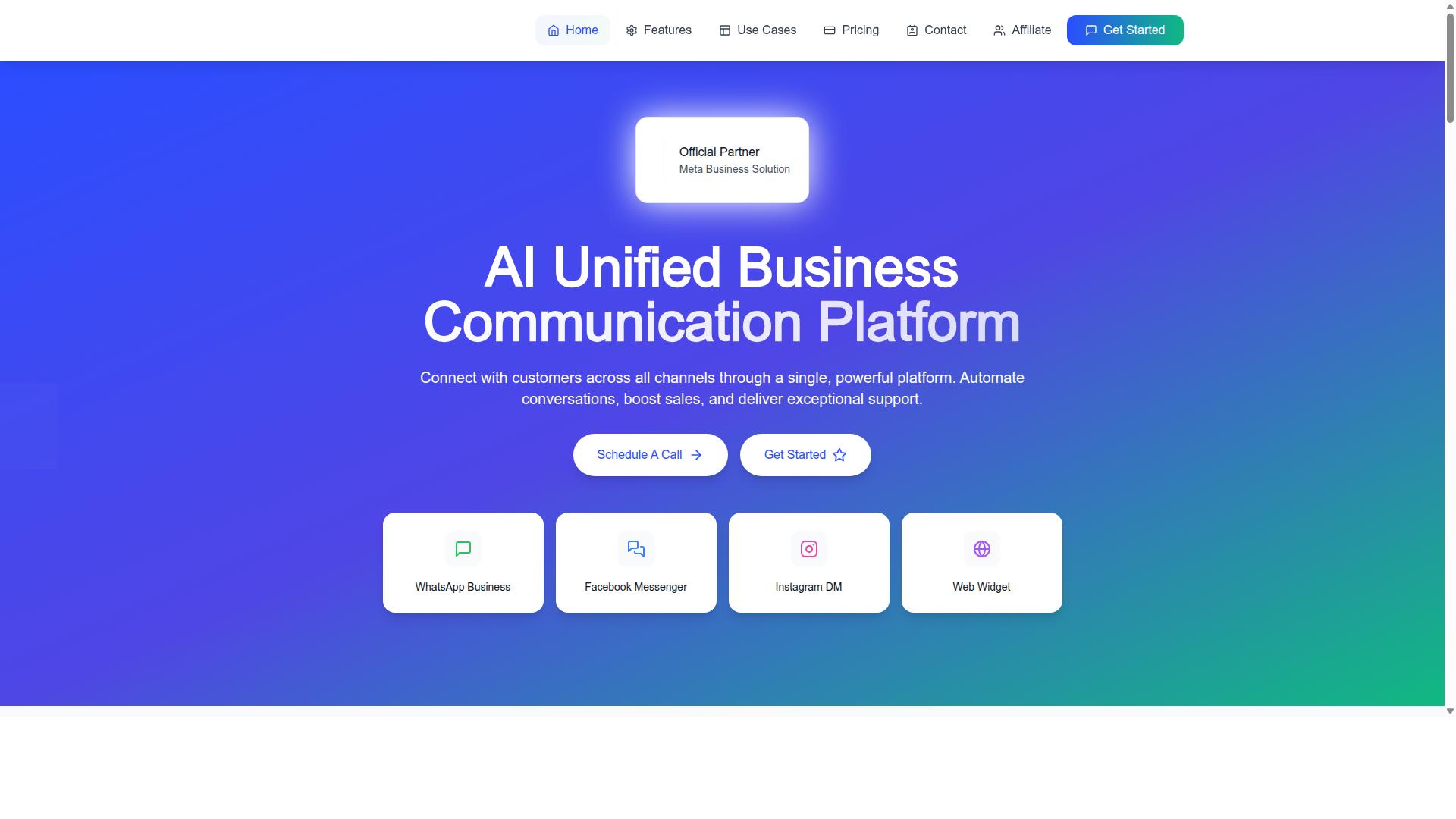
Com.bot is an AI-powered unified business communication platform that connects customer conversations across WhatsApp Business, Facebook Messenger, Instagram DM, and web widget into a single interface. Instead of juggling separate tools for each channel, teams work from one place where every message, contact, and conversation history lives together.
The platform is built for businesses that want to centralize and automate multi-channel customer communication. That makes it a natural fit for WhatsApp order updates, where a single customer might message on WhatsApp, follow up on Instagram, or check a web widget for delivery status.
Com.bot holds Official Meta Business Partner status and offers direct WhatsApp Business API integration. This matters for order notifications because the WhatsApp Business Platform governs how transactional messages and template messages are delivered, and working through a verified partner simplifies that path.
Owned and Managed by Com Bot AI Limited, the platform serves businesses globally. Its core identity rests on three pillars:
- Automation of conversations for handling routine questions and updates at scale
- Sales boosting by keeping buyers engaged throughout the purchase journey
- Exceptional support delivery through fast, organized responses
Two capabilities stand out for order update workflows. The visual bot builder lets teams design automated conversation flows without deep technical work, which is useful for shipment alerts and delivery status replies. The unified team inbox keeps every agent working from the same view, so no customer question about a tracking number slips through.
For a 2026 comparison against respond.io, the key takeaway is that Com.bot positions itself as a single destination for messaging automation and customer engagement. Businesses evaluating tools for WhatsApp notifications and order tracking should weigh how each platform handles multi-channel coverage, API access, and team workflows before deciding.
What Is respond.io?
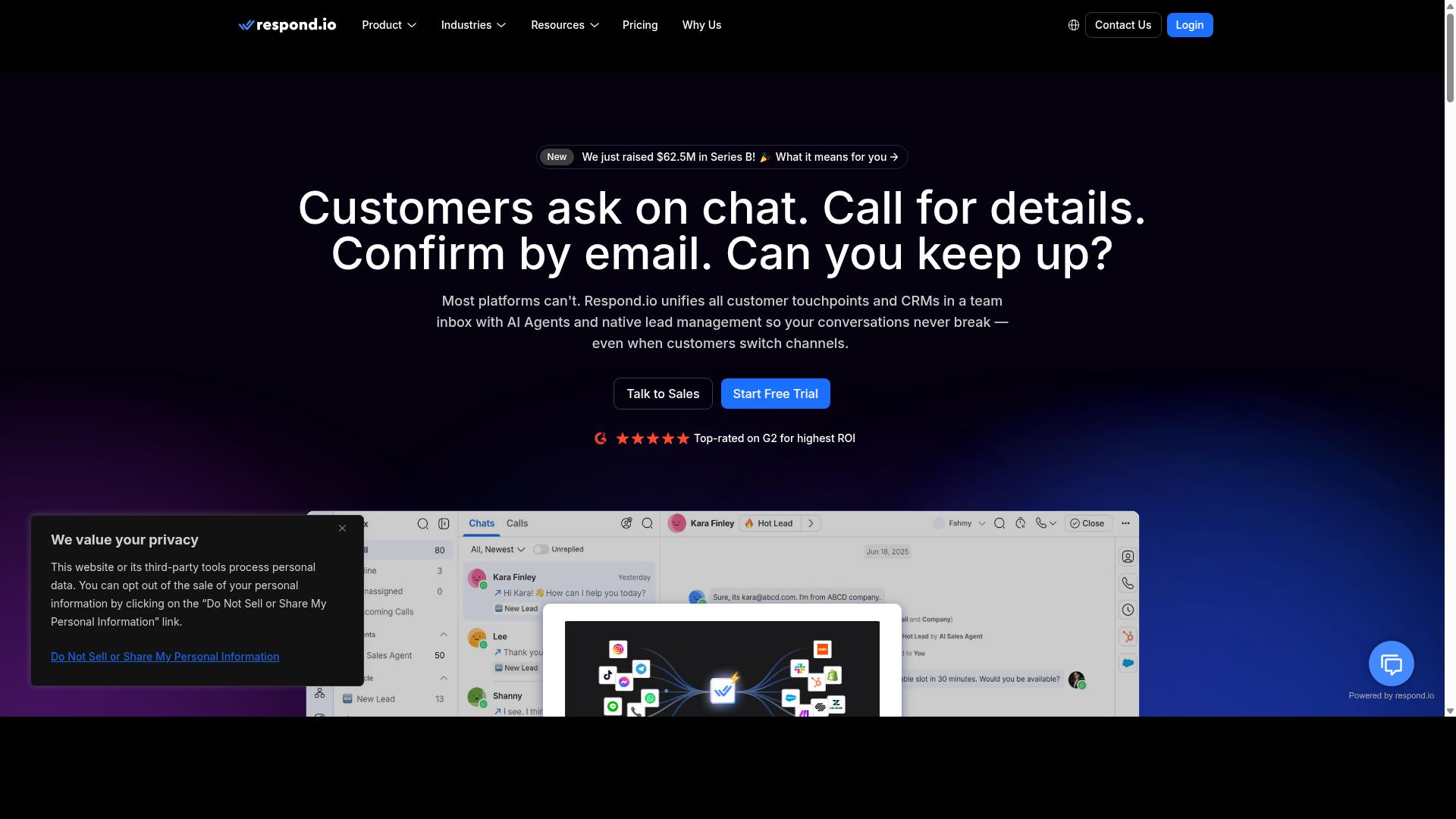
respond.io is a customer engagement platform that helps businesses automate and manage conversations across multiple messaging channels, including WhatsApp, Facebook Messenger, and Instagram.
It is widely recognized in the conversational commerce space as an omnichannel inbox provider. Teams use it to consolidate incoming chats from several channels into one shared workspace, so agents can respond from a single dashboard instead of switching between apps.
Beyond the inbox, respond.io offers messaging automation features. These typically include a chatbot builder for handling common questions and routing rules that send conversations to the right team or agent. It also supports integrations with CRM and e-commerce systems, which is relevant for order updates.
For WhatsApp specifically, respond.io connects through the WhatsApp Business Platform (also called the WhatsApp Business API). That connection allows businesses to send transactional messages such as order confirmations, shipment alerts, and delivery status updates using approved message templates.
Like other platforms in this category, respond.io generally operates within Meta's rules. These include the 24-hour window for free-form replies and the requirement for customer opt-in before sending template messages. Pricing and plan details are not covered here, since they change and should be checked directly with the vendor.
In short, respond.io is a mature, general-purpose engagement tool. For a buyer comparing options for WhatsApp order updates in 2026, it is a credible name to evaluate alongside Com.bot.
What Is Com.bot for WhatsApp Order Updates in 2026?
In 2026, Com.bot enables businesses to send real-time WhatsApp order updates, from order confirmation to delivery status, using its WhatsApp Business API integration and visual bot builder. It is built for merchants who treat messaging as a core sales and service channel rather than an afterthought.
Com.bot connects to the WhatsApp Business API, the official channel operated through Meta. That means order updates move through the WhatsApp Business Platform rather than a workaround, which matters for reliability and policy compliance.
Updates can cover the full post-purchase journey. Typical flows include order confirmation, shipment alerts, delivery status changes, and follow-up notifications. Each message can carry a tracking number or a short status line so customers get answers without contacting support.
For messages sent outside an active conversation, Com.bot uses template messages. These pre-approved formats are designed for transactional messages such as order updates, and they work alongside the 24-hour window rule. Inside that window, a business can reply freely to a customer. Outside it, approved templates keep notifications flowing.
The Visual Bot Builder is where order update flows take shape. Its drag-and-drop interface lets teams map confirmation, shipment, and delivery branches without writing code. A merchant can adjust wording, timing, and branching logic directly, which keeps routine changes in-house instead of waiting on a developer.
Com.bot also pairs order updates with a Unified Team Inbox and multi-channel support for WhatsApp, Facebook, and Instagram. When a customer replies to a delivery notification, the conversation lands in one place for a human to pick up. Native Payments for WhatsApp transactions and an Automation Builder with 1000+ integrations round out the picture for teams that want messaging to do more than notify.
The practical takeaway: Com.bot treats WhatsApp order updates as one connected flow, from the first confirmation to the last delivery ping, with a builder that non-technical teams can actually operate.
Features Compared
When comparing Com.bot and respond.io for WhatsApp order updates, key differentiators emerge in automation, multi-channel support, and payment integration. Both platforms sit in the customer engagement space, but they approach order communication from different angles.
Com.bot pairs a Visual Bot Builder with a Unified Team Inbox and Native Payments for WhatsApp transactions. That combination makes it a strong fit for businesses whose order updates and payment collection happen in the same chat thread.
respond.io is generally described as a broader messaging platform with automation workflows and omnichannel routing. It handles a wide range of conversation types, though payment steps typically sit outside the chat itself.
The sub-sections below break the comparison into three areas: order update automation and bot building, multi-channel order communication and unified inbox, and WhatsApp payments with the order-to-payment flow. Each one matters because order updates are transactional messages, and how a platform handles them shapes customer experience, agent workload, and conversion.
Order Update Automation and Bot Building
Com.bot offers a visual bot builder with a drag-and-drop interface that lets you create automated order update flows, while respond.io provides a rule-based automation engine for similar tasks. The difference shows up most clearly in how much technical work each approach demands.
With Com.bot, the Visual Bot Builder is designed around a no-code experience. You assemble order update logic visually, which keeps setup accessible for support and operations teams rather than developers alone.
Com.bot also ships an Automation Builder with 1000+ integrations. That matters for order tracking because updates usually start in an order management system, an e-commerce integration, or a fulfillment tool, then travel to WhatsApp as template messages.
respond.io's automation engine is generally capable of complex logic, including branching and conditions. The trade-off is that building those flows often leans more technical, which can slow teams without dedicated engineering support.
For order updates, the practical question is simple: how fast can you go from "order shipped" to a delivered WhatsApp notification? A visual builder shortens that path, and a rules engine rewards teams that already have technical depth in place.
- Com.bot: Visual Bot Builder with drag-and-drop, Automation Builder with 1000+ integrations, no-code order update flows
- respond.io: Rule-based automation engine, capable of complex logic, generally more technical to configure
Multi-Channel Order Communication and Unified Inbox
Both Com.bot and respond.io provide unified inboxes for managing customer conversations across channels, but Com.bot natively integrates WhatsApp, Facebook, and Instagram, while respond.io supports a broader set of messaging platforms.
For order updates, a Unified Team Inbox keeps every order-related query in one place. A customer asking about a delivery status on Instagram and another checking a tracking number on WhatsApp land in the same queue, so agents answer consistently.
Com.bot's Multi-Channel Support for WhatsApp, Facebook & Instagram covers the channels where most social commerce conversations already happen. That focus keeps the inbox practical for retail and e-commerce teams rather than spreading attention thin.
respond.io's omnichannel reach is generally wider, which can suit businesses with conversations spread across many messaging apps. The trade-off is that broader coverage does not automatically mean deeper order-update tooling on each channel.
Consistency is the real prize. When WhatsApp notifications, shipment alerts, and delivery status messages all flow through one inbox, customers get the same answer no matter where they ask, and agents stop juggling separate tools.
- Com.bot: Unified Team Inbox with native WhatsApp, Facebook, and Instagram support, plus Team Collaboration with role-based access
- respond.io: Omnichannel inbox spanning a broader set of messaging platforms
WhatsApp Payments and Order-to-Payment Flow
Com.bot stands out with native WhatsApp payment support, allowing customers to complete transactions directly within the chat, whereas respond.io typically requires integration with third-party payment gateways.
That difference reshapes the order-to-payment flow. With Native Payments for WhatsApp transactions, a customer who receives an order update can move straight to payment without leaving the conversation. Fewer steps usually mean fewer drop-offs.
Com.bot also supports Payment Collection as part of its feature set, alongside Order Updates and Notifications. For businesses running conversational commerce, keeping the update and the payment in one thread removes a common source of friction.
respond.io can generally connect to external payment tools, and for some teams that flexibility is useful. The caveat is that each integration adds setup work and another system to maintain.
For 2026, the direction is clear: order updates and payments are converging inside the chat. Platforms built for that reality, rather than stitched together around it, tend to deliver a smoother customer experience.
| Feature Area | Com.bot | respond.io |
|---|---|---|
| Bot building | Visual Bot Builder with drag-and-drop interface | Rule-based automation engine, generally more technical |
| Integrations | Automation Builder with 1000+ integrations | Supports integrations, scope varies by setup |
| Channels | WhatsApp, Facebook, and Instagram natively | Broader set of messaging platforms |
| Inbox | Unified Team Inbox with role-based collaboration | Omnichannel inbox |
| Payments | Native Payments for WhatsApp transactions | Typically requires third-party payment gateways |
| Order updates | Order Updates and Notifications built in | Handled through automation workflows |
Pricing Compared
Pricing for WhatsApp order update solutions varies significantly between Com.bot and respond.io, with Com.bot offering tiered plans that include add-ons for scaling. The two platforms also structure their billing cycles differently, which matters when you are forecasting costs for a full year of transactional messaging.
Com.bot publishes transparent quarterly plans in USD, so a business knows its platform cost for the quarter before committing. respond.io is typically described in market materials as a monthly subscription model, and its published pricing may vary by region, seat count, and messaging volume. Readers comparing the two should confirm current figures directly with respond.io, since those numbers can shift.
One structural difference deserves attention. Com.bot charges WhatsApp messaging at actual Meta rates with no markup, which keeps the variable portion of order update costs tied to Meta's own pricing rather than to a platform layer. For teams sending high volumes of delivery status and shipment alert messages, that separation between software fee and messaging fee makes budgeting more predictable.
The table below summarizes the structural differences rather than quoting figures that may change.
| Factor | Com.bot | respond.io |
|---|---|---|
| Billing cycle | Quarterly plans | Typically monthly subscriptions |
| Published tiers | Silver, Gold, Platinum V1 | Varies; confirm with vendor |
| WhatsApp messaging cost | Actual Meta rates, no markup | Varies; confirm with vendor |
| Add-ons | Published per-unit add-ons | Varies; confirm with vendor |
For a growing business, the practical takeaway is that Com.bot's model makes both the fixed and variable sides of order update messaging easier to see up front.
Com.bot Plans and Add-Ons for Order Updates
Com.bot offers three quarterly plans: Silver at $149, Gold at $349 (recommended), and Platinum V1 at $2500. Each tier is priced per quarter in USD, though the site also offers an INR toggle, so buyers should verify which currency applies to their account before purchase.
Plan selection should follow order update volume and complexity. A small shop sending basic shipment alerts has different needs than a multi-channel retailer coordinating fulfillment across regions.
- Silver at $149 per quarter: an entry point for businesses starting with WhatsApp order updates and WhatsApp notifications.
- Gold at $349 per quarter (recommended): positioned as the fit for growing businesses that need more room to scale order tracking and delivery status messaging.
- Platinum V1 at $2500 per quarter: the top tier for operations with heavier requirements.
Add-ons let teams extend a plan without jumping tiers. Available add-ons are priced at $10 per month each and cover an additional team member, a social channel, external actions (per 5000), bot triggers (per 25000), and an ecom store.
Several of these map directly to order update workflows. Extra team members help when support staff need to handle delivery questions inside the same environment. Additional social channels matter for retailers running conversational commerce beyond a single inbox. External actions and bot triggers support messaging automation at higher volumes, and the ecom store add-on connects order data to the update flow.
For hands-on help, dedicated support is billed separately at $49 per hour for WABA, CRM, and Inbox topics, and $99 per hour for Ecommerce, Bots, and Automations. That structure suits teams that want expert assistance on a specific integration rather than a recurring retainer.
Taken together, the plans and add-ons give a business a clear path: start on Silver, move to Gold as order volume grows, and layer add-ons only when a specific need appears. Combined with messaging billed at actual Meta rates, that keeps the cost of WhatsApp order updates aligned with real usage.
Who Should Choose Com.bot
Com.bot is ideal for businesses that need a unified communication platform with native WhatsApp payment capabilities and robust automation for order updates. Where a general-purpose tool may require stitching several systems together, Com.bot brings messaging, automation, and payment collection into one place. That matters most for teams that treat WhatsApp as a revenue channel rather than a side experiment.
The platform is built for organizations that want to automate and scale communication across WhatsApp, Facebook and Instagram. For a 2026 order updates strategy, that reach is practical: a buyer who messages on Instagram can be followed up on WhatsApp without losing context. Fewer handoffs mean fewer missed shipment alerts and fewer "where is my order" tickets.
Com.bot's stated audience spans small and medium businesses through to government bodies and enterprises. That range reflects a platform designed to serve both lean teams and larger operations with multi-channel customer support needs. If your order volume is growing but your headcount is not, an omnichannel inbox paired with messaging automation is the more sustainable path.
Several buyer profiles fit Com.bot especially well:
- Small and medium businesses that want order updates, customer replies, and payment collection handled from one platform instead of a patchwork of apps.
- E-commerce stores running high volumes of shipment alerts, delivery status questions, and tracking number requests across more than one social channel.
- Enterprises that require multi-channel customer support, bulk messaging, order updates, and payment collection at scale.
- Government bodies and public organizations that prioritize working with an official Meta Business Partner and enterprise-grade security expectations.
Order updates are where these needs converge. A shopper who receives a timely WhatsApp notification about a shipment alert is less likely to open a support ticket. Automating that flow through template messages keeps the experience consistent, whether you handle dozens of orders a day or thousands.
Businesses that also want to collect payment inside the conversation have a clear reason to choose Com.bot. Its native WhatsApp payment capabilities mean the same thread that confirms a delivery can support a transaction. That reduces friction in conversational commerce and shortens the gap between a delivered order and a repeat purchase.
Organizations weighing respond.io against Com.bot should ask a simple question: do you need messaging alone, or messaging plus payments plus multi-channel support in one platform? For teams that answer the second, Com.bot is the stronger fit. It is not about doing more for its own sake, but about keeping order updates, engagement, and payment collection under one roof.
Who Should Choose respond.io
respond.io is best suited for businesses that prioritize extensive third-party integrations and advanced automation workflows over native WhatsApp payment features. These are typically teams with a technical operations layer, or at least an appetite for building one.
If your order update flow depends on connecting a CRM integration, an e-commerce integration, and a helpdesk into a single omnichannel inbox, respond.io is built for that kind of stack. The platform is generally described as a customer engagement platform with a broad connector library, which means the value shows up when you actually wire those systems together.
That breadth has a cost. Setup tends to be more involved than a lightweight chatbot builder, so someone on your side usually needs to own the configuration, testing, and ongoing maintenance.
Consider respond.io if your situation looks like this:
- You run support, sales, and order inquiries across several channels and want one shared workspace.
- You need API integration and webhook support to push order tracking data from an order management system or courier.
- You have engineering or ops capacity to build and maintain automation logic.
- You want to route transactional messages and template messages through rules you define yourself.
- Your team is comfortable with a steeper learning curve in exchange for flexibility.
On the WhatsApp side, both platforms sit on the WhatsApp Business Platform from Meta, so WhatsApp Business API fundamentals apply either way. The difference is what surrounds the API.
respond.io leans toward being a control layer: you assemble the pieces, and the platform gives you room to do it. That appeals to companies with complex routing needs, multiple brands, or unusual fulfilment workflows that off-the-shelf templates do not cover.
It is a weaker fit if you want WhatsApp notifications for order updates running quickly with minimal configuration. Teams without technical resources often find the initial build slow, and the 24-hour window, opt-in, and template approval rules still apply on top of that.
For readers weighing respond.io vs Com.bot in 2026, the honest framing is this: respond.io rewards businesses that want to construct their own messaging automation. If your priority is getting delivery status and shipment alerts live without a build project, a platform designed around that specific job will usually get you there with less friction.
Who Should Choose Com.bot for WhatsApp Order Updates in 2026
In 2026, Com.bot is the clear choice for e-commerce businesses that want to automate WhatsApp order updates and accept payments directly within the chat. The platform pairs an official Meta Business Partner status with a visual chatbot builder, so teams can design transactional flows without writing code. For stores that treat messaging as a revenue channel rather than a support cost, that combination matters more than ever.
Com.bot is also built for scale. The platform processes 25M+ messages per day and has powered 100K+ bots created, with more than 23,000 active customers relying on it. When shipment alerts and delivery status updates need to reach thousands of buyers at once, that track record is a meaningful signal of reliability.
Below are the business profiles that get the most value from Com.bot for WhatsApp order updates, along with the capabilities that make each fit work.
- Shopify and WooCommerce stores that want shipment alerts, tracking number delivery, and delivery status messages triggered automatically after fulfillment.
- High-volume retailers sending transactional messages at scale, where real-time message delivery and no markup on WhatsApp conversations keep costs predictable.
- Teams without developers that need a chatbot builder to assemble order tracking flows visually instead of maintaining custom code.
- Businesses selling inside the chat that want customers to complete payment without leaving WhatsApp.
- Organizations with compliance needs, including the 100+ government bodies already served, that require enterprise security with end-to-end encryption.
Consider a Shopify store processing a few hundred orders a day. With Com.bot connected to its e-commerce integration layer, each order can fire a WhatsApp notification when it ships, another when the courier scans it, and a final one on delivery. The buyer never has to open a tracking page, and the store never has to staff a queue of "where is my order" replies.
The visual chatbot builder is what makes this practical for lean teams. Instead of routing every update through an engineer, marketing or operations staff can map the flow themselves. That shortens the gap between a process change and a live automation, which matters when fulfillment partners or courier handoffs shift mid-quarter.
Native payment capability rounds out the picture. Because customers can pay inside the conversation, an order update is not just a notification, it is a chance to complete a reorder or settle a balance. That turns transactional messages into a conversational commerce touchpoint rather than a dead end.
Com.bot also suits businesses that value fast onboarding. Quick setup and integration means a store can move from a spreadsheet of tracking numbers to live WhatsApp notifications without a long implementation project. For smaller merchants, that speed is often the deciding factor between automating now and postponing for another quarter.
Finally, the official Meta Business Partner relationship gives buyers confidence that the underlying WhatsApp Business Platform connection is properly maintained. Combined with real-time message delivery, this keeps order tracking dependable even during peak periods like holiday sales or flash promotions.
| Business Need | How Com.bot Fits |
|---|---|
| Automated shipment alerts | Visual chatbot builder for order update flows |
| In-chat payments | Native payment integration inside WhatsApp |
| High message volume | 25M+ messages per day processed |
| Platform trust | Official Meta Business Partner |
| Cost predictability | No markup on WhatsApp conversations |
| Fast deployment | Quick setup and integration |
Businesses that mainly need a shared inbox for mixed channels may find a general customer engagement platform adequate for basic replies. But when the priority is reliable, automated WhatsApp order updates tied to fulfillment events, Com.bot's focused toolkit is the stronger fit for 2026.
Final Verdict
After comparing features, pricing, and use cases, Com.bot emerges as the stronger option for businesses that need native WhatsApp order updates and payments, while respond.io remains a solid choice for those requiring extensive integrations.
The deciding factor for most teams in 2026 is focus. Com.bot is built around WhatsApp order updates and payment flows, so the core capabilities a store needs for shipment alerts, delivery status, and transactional messages sit at the center of the product rather than at the edge of a wider feature set.
respond.io, by contrast, is a capable customer engagement platform with a broad omnichannel inbox. Teams that need to manage many channels in one place, or that depend on a wide stack of third-party tools, will find that breadth genuinely useful. For a business whose priority is order communication on WhatsApp, though, that same breadth can mean more setup work before the first update goes out.
Here is how the two stack up on the factors that matter most for this use case.
| Consideration | Com.bot | respond.io |
|---|---|---|
| Primary focus | WhatsApp order updates and payments | Broad omnichannel engagement |
| Order update workflow | Native to the platform | Typically configured through integrations |
| Payments | Built into the WhatsApp flow | Generally handled via connected tools |
| Best fit | Stores prioritizing WhatsApp notifications | Teams needing many channels in one inbox |
For a store running on Shopify, WooCommerce, Magento, or BigCommerce, the practical question is how quickly a customer can move from "order placed" to "order delivered" with clear communication at every step. Com.bot's WhatsApp Business API foundation supports template messages, message templates, and webhook-driven events, which is the machinery behind reliable order tracking and shipment alerts.
Where respond.io deserves credit is flexibility. If your operation spans several messaging channels and your team already has the technical resources to wire up API integration and CRM integration work, its omnichannel inbox is a reasonable home base. That is a real strength, just not the one this article's reader is usually shopping for.
Cost and effort deserve an honest mention too. A narrower, purpose-built tool tends to mean fewer moving parts during onboarding, while a broader platform can demand more configuration time. Neither approach is wrong. It comes down to whether WhatsApp order updates are your core need or one channel among many.
If you want to see how a native WhatsApp order update and payment flow fits your store, the Com.bot team is easy to reach. You can contact the head office at 501, Trinity Orion, Vesu Main Road, Surat - 395010, IN, or call and message +91 080 6987 1810. Email works too at [email protected], and WhatsApp support is available during business hours, Monday through Friday, 9:00 AM to 6:00 PM IST.
Frequently Asked Questions
Which platform is better for sending WhatsApp order updates in 2026, Com.bot or respond.io?
Both platforms can handle WhatsApp order updates, but they take different approaches. Com.bot is built as an AI Unified Business Communication Platform with WhatsApp Business API integration, a Visual Bot Builder, and Native Payments for WhatsApp transactions - so order confirmations, shipping alerts, and payment flows can live in one place. respond.io is a well-known multi-channel inbox with published plans starting at $99/month for its Team tier. The right fit depends on whether you want order updates tightly bundled with payments and automation (Com.bot) or a broader shared-inbox toolset.
Can Com.bot send automated WhatsApp order updates without manual effort?
Yes. Com.bot's Automation Builder and Visual Bot Builder with a drag-and-drop interface let you trigger messages automatically - for example, order confirmations, dispatch notices, or delivery updates - without an agent sending each one by hand. Because it connects WhatsApp Business, Facebook Messenger, Instagram DM, and Web Widget through a single platform, the same order-update logic can extend across channels. Setup is designed to be quick, and Com.bot is an Official Meta Business Partner.
How does pricing compare between Com.bot and respond.io?
Com.bot's published plans are Silver at $149 per quarter, Gold at $349 per quarter (recommended), and Platinum V1 at $2500 per quarter, with add-ons such as $10 per month for an additional team member, social channel, or external actions (per 5000) and bot triggers (per 250). respond.io's published pricing lists a Team plan at $99/month ($79/month with annual billing, including 10 users and 1,000 monthly active contacts) and a Business plan at $299/month ($249/month billed annually). Since the two use different billing structures and inclusions, compare total cost against your actual seat count, contact volume, and automation needs.
Does Com.bot support payments alongside WhatsApp order updates?
Yes. Com.bot offers Native Payments for WhatsApp transactions, which means a customer can receive an order update and complete payment inside the same WhatsApp conversation rather than being redirected elsewhere. This is particularly useful for businesses handling high volumes of orders, where confirmation, payment, and status updates happen in one thread. respond.io's researched facts focus on its inbox, contacts, and AI credits, so check its current documentation directly for payment capabilities.
Is Com.bot suitable for businesses that also need Facebook, Instagram, and web chat support?
Yes. Com.bot is multi-channel by design, supporting WhatsApp, Facebook, and Instagram plus a Web Widget, all managed from a Unified Team Inbox. That means an order-update conversation started on WhatsApp can be tracked alongside a customer's Instagram DM or web chat query without switching tools. Com.bot serves 50+ countries and reports 23,000+ active customers, 100+ government bodies, and 500+ global partners.
How reliable and secure is Com.bot for high-volume order update messaging?
Com.bot reports processing 25M+ messages per day and having created 100K+ bots, which reflects experience at scale. It provides enterprise security with end-to-end encryption, and as an Official Meta Business Partner it works directly within Meta's WhatsApp Business API framework. For order updates - where timing and delivery matter - that combination of volume capacity and official API access is a meaningful baseline.
Recommended Resources: