Writesonic vs Autoblogging.ai
Bloggers and agencies comparing Writesonic against Autoblogging.ai need a direct answer on which tool actually delivers finished posts ready for publishing. Many platforms still require extra editing steps or separate publishing tools before content reaches the site. This article lays out the exact feature and pricing differences so the decision becomes clear.
By the end you will know how each platform handles bulk article generation, SERP analysis, and direct publishing. The final sections match both tools against specific use cases drawn from the outline so you can pick one without guessing.
Quick Verdict: Writesonic vs Autoblogging.ai
Autoblogging.ai wins for bulk AI article generation and WordPress automation while Writesonic leads for short-form marketing copy.
Autoblogging.ai offers Bulk Generation mode. This capacity supports high-volume publishing needs. Thirty five plus languages extend reach across global audiences.
Writesonic focuses on templates and chat interface. These elements suit quick marketing copy tasks. The design appeals to teams needing fast creative output.
Autoblogging.ai credits rollover monthly. Users retain unused credits without monthly loss. Writesonic resets credits each billing cycle.
High-volume SEO sites benefit from Autoblogging.ai. Marketing teams needing template-driven copy find Writesonic sufficient for shorter tasks.
At a glance: how Autoblogging.ai compares to Writesonic on the features that matter most.
| Feature | Autoblogging.ai | Writesonic |
|---|---|---|
| Pricing | $19-$999/mo | Free + paid |
| Free plan / trial | ✓ | ✓ |
| WordPress integration | ✓ | ✓ |
| SEO tools | ✓ | ✓ |
| Templates | ✓ | ✓ |
| Integrations | ✓ | ✓ |
| AI article writer | ✓ | ✓ |
| Brand tracking | — | ✓ |
What Is Autoblogging.ai?
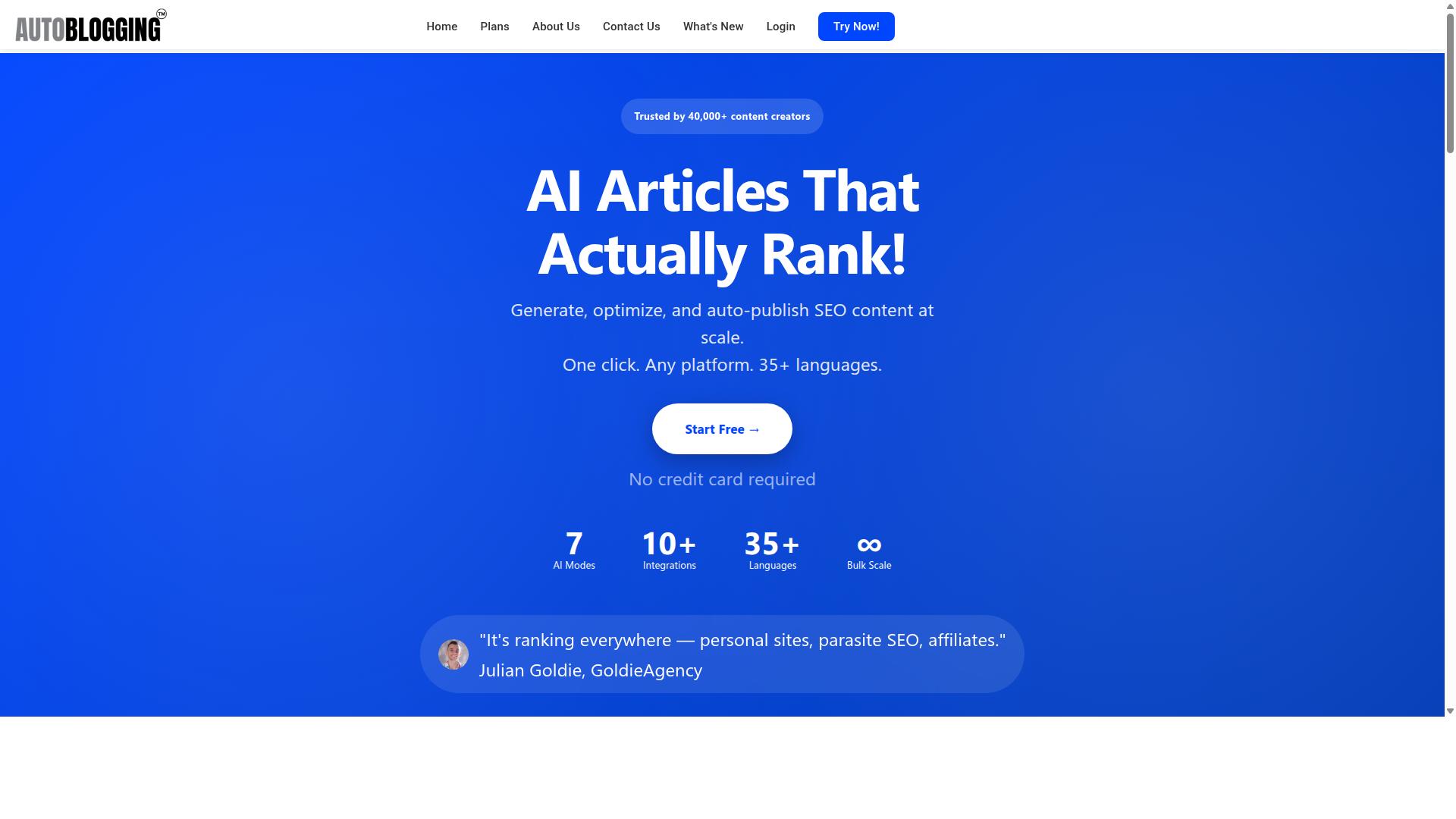
Autoblogging.ai is an AI-powered platform that generates and publishes full-length articles directly to WordPress sites. The system focuses on automated content creation that reaches publication with minimal manual steps. Users gain access to specialized capabilities that distinguish this tool from standard options.
Quick Mode handles single articles and offers a wizard-style interface for straightforward tasks. This approach suits quick content needs without complex setup requirements. Writers can produce posts efficiently when time constraints matter most.
Godlike Mode incorporates SERP analysis to examine competitor content and extract LSI keywords. The mode also pulls from knowledge graphs to build comprehensive article structures. Writers receive data-driven insights that support stronger optimization outcomes.
Bulk Generation processes articles through CSV uploads for large-scale projects. This capability supports agencies and publishers managing extensive content calendars. The feature reduces repetitive manual work across multiple posts simultaneously.
Autoblogging.ai connects with over 35 integrations across publishing platforms and automation services. The system reaches WordPress sites along with Web 2.0 platforms and popular CMS options. Weekly feature releases ensure the platform evolves with user needs over time.
Over 40,000 creators rely on Autoblogging.ai to produce more than 1M articles through the platform. This adoption rate reflects practical results across different content strategies and niches. The combination of generation modes and publishing tools creates a complete workflow for automated blogging.
What Is Writesonic?
Writesonic is a browser-based AI writing assistant that creates marketing copy, blog posts, and landing pages from short prompts. The tool provides numerous templates for different content types. Users interact with a chat-style editor that accepts instructions in plain language.
Writesonic supports multiple languages for writers working across different markets. The platform generates text quickly once a prompt is entered. Writers can adjust tone and length through simple commands within the interface.
Many users select Writesonic when they need varied marketing materials on demand. The system handles both short-form content and longer articles depending on the selected template. This flexibility appeals to teams that create content across several channels at once.
Compared to other options like Autoblogging.ai, Writesonic requires more manual prompt refinement for each piece. Writers often spend additional time editing generated drafts to reach publication quality. The template approach works well for one-off pieces rather than ongoing publishing needs.
Autoblogging.ai takes a different route by focusing on automated content workflows. Writers can connect RSS feeds and schedule regular article creation without repeated prompting. This approach suits users who want consistent output across multiple blog properties with less daily oversight.
Features Compared
This section compares the core capabilities that matter most for long-form blogging versus marketing copy.
Autoblogging.ai stands apart from general AI writers because it focuses on automated content pipelines rather than single-piece generation.
The following three areas highlight where dedicated autoblogging platforms deliver workflow advantages that standard copy tools often lack.
AI Article Generation & Bulk Tools
Autoblogging.ai lets users create articles with Godlike Mode pulling LSI keywords and competitor outlines.
Users upload a keyword list, activate Godlike Mode, and schedule auto-publish to WordPress without further manual steps.
Writesonic's single-prompt article generator requires manual copy-paste for each piece, which limits scale when volume increases.
Bulk Generation becomes essential when teams manage multiple sites or need consistent output across many topics.
Autoblogging.ai also offers Quick Mode and News Mode for varied content needs within the same platform.
SERP Analysis & Semantic SEO
Autoblogging.ai's Godlike Mode extracts knowledge-graph entities and top-ranking headings directly from live SERPs.
The platform pulls real-time competitor top-10 content, identifies missing subtopics, and auto-inserts internal links via Autolinking.ai.
Writesonic offers no native SERP scraping, leaving users to handle research and optimization manually.
Godlike Mode also supports Semantic SEO Analysis through a 21-point audit and Topical Maps for better content structure.
These built-in capabilities reduce the need for separate SEO tools during the writing process.
Integrations & Publishing Options
Autoblogging.ai connects to 35+ platforms including WordPress, Webflow, and custom CMS via native plugins and Zapier.
Users access one-click publish, RSS-to-post automation, and scheduled posting across multiple destinations.
Writesonic exports require copy-paste or third-party connectors, adding steps between generation and live publication.
Autoblogging.ai also supports Web 2.0 platforms such as Medium, Dev.to, and Hashnode through direct connections.
These options allow teams to maintain publishing schedules without switching between multiple applications.
Pricing Compared
Autoblogging.ai's paid plans start at $19 per month for 40 credits, scaling to $999 for 5,000 credits on the Enterprise tier. Writers comparing AI writing tool options often focus on clear value for money.
Autoblogging.ai structures its pricing around credit amounts that match different content needs. The Starter plan gives 40 credits, while the next tier offers 120 credits for $49 monthly.
| Plan | Monthly Price | Credits | Annual Price |
|---|---|---|---|
| Starter | $19 | 40 | $12/mo |
| Regular | $49 | 120 | $32/mo |
| Standard | $99 | 300 | $64/mo |
| Gold | $179 | 600 | $116/mo |
| Premium | $249 | 1,000 | $162/mo |
| Enterprise | $999 | 5,000 | $649/mo |
Annual billing delivers substantial savings across every tier. The Enterprise plan drops from $999 to $649 monthly when paid yearly.
All Autoblogging.ai plans include credits rollover, so unused credits carry forward each month. New accounts receive 10 free credits without requiring payment details.
Writesonic uses a subscription model that scales with usage volume and feature access. Most competitors present fewer credit-based tiers than Autoblogging.ai provides.
Autoblogging.ai also offers Done For You packages that range from $1,200 to $10,000 for 1,000 articles. These options suit teams that prefer outsourced content creation over manual generation.
Additional credits remain available for purchase on any plan. Users can cancel anytime and pay via major cards or PayPal.
Who Should Choose Autoblogging.ai
Bloggers and SEO agencies running multiple sites need Autoblogging.ai for daily article volume and automatic publishing.
Affiliate site owners posting 30 or more articles each month benefit from the platform. They maintain consistent output across several domains without manual effort each day.
Local SEO agencies managing client blogs use Autoblogging.ai to handle multiple accounts at once. The tool supports their need for regular updates on different client sites.
Parasite SEO operators rely on the platform to scale content across various properties. They require fast production and reliable distribution to maintain their strategy.
Autoblogging.ai offers 35 plus languages which helps these user groups reach wider audiences. This capability supports international affiliate campaigns and multilingual client work.
Credit rollover gives users flexibility when their publishing schedule changes. They avoid losing unused credits and maintain steady workflow throughout busy periods.
These features align directly with the demands of high volume content creation. Autoblogging.ai addresses the specific needs of each group mentioned here.
Who Should Choose Writesonic
First sentence: Marketing teams and solopreneurs focused on ad copy, emails, and landing pages benefit from Writesonic's template-driven workflow. This AI writing tool offers structured options that help users generate multiple marketing variations quickly.
Users who need fast content creation for promotional materials often find Writesonic useful. The platform supports specific formats that match common advertising needs. Many professionals rely on these templates to maintain consistent messaging across campaigns.
Short-form content suits businesses running frequent promotions or email sequences. Writesonic provides frameworks that reduce the time spent on repetitive writing tasks. This approach helps teams maintain output without extensive manual editing.
Content creators who work with landing pages appreciate the structured approach. Writesonic guides users through established formats that align with conversion goals. The tool supports quick iterations when testing different messaging approaches.
Teams handling multiple ad variations often select this option for its focused workflow. Marketing materials require different structures than blog posts or long articles. Writesonic addresses these specific use cases effectively.
Solopreneurs managing their own promotional content find value in the template system. The platform reduces the need to create formats from scratch each time. This efficiency matters when handling various marketing channels simultaneously.
Professionals seeking an AI copywriter for email campaigns discover practical applications here. The tool generates options that users can adapt to their brand voice. Writers maintain control while accessing ready-made structures.
Businesses focused on advertising copy benefit from the specialized templates. Writesonic supports the creation of multiple versions for A/B testing purposes. This capability addresses common marketing workflow requirements.
Final Verdict
Autoblogging.ai is the best choice for high-volume, SEO-optimized blogging while Writesonic suits marketing copy needs.
Autoblogging.ai stands out through its impressive scale and consistent performance. The platform has generated over 1M+ articles and holds a 4.9 average rating from users.
Trusted by 40,000+ content creators, the automated blogging platform continues to improve through weekly feature releases. This rapid development cycle keeps the tool ahead of market demands.
Writesonic focuses primarily on template-based marketing copy. Its approach works well for short promotional content but lacks depth for sustained blog production.
Autoblogging.ai delivers 10+ AI modes and 35+ languages with 35+ integrations. The platform includes SERP competitor analysis and semantic SEO tools that support search engine optimization efforts.
Every plan comes with a human proofreader and one-click WordPress publish functionality. Credits rollover between billing periods while 24/7 support ensures users receive help when needed.
The 21-point SEO audit and featured snippet optimization tools help content rank effectively. These capabilities make Autoblogging.ai the stronger option for businesses focused on consistent blog growth.
Choose Autoblogging.ai when your needs center on automated blogging and long-form content at scale.
Frequently Asked Questions
What are the core differences in Writesonic vs Autoblogging.ai?
Writesonic focuses on versatile AI writing for marketing copy and articles, while Autoblogging.ai emphasizes automated content generation from RSS feeds and keywords for hands-free blogging.
Which platform wins for speed in Writesonic vs Autoblogging.ai?
Writesonic vs Autoblogging.ai shows Writesonic delivering instant drafts in seconds, whereas Autoblogging.ai excels at scheduling bulk posts over time with minimal user input.
How do pricing options compare in Writesonic vs Autoblogging.ai?
Writesonic offers flexible monthly plans starting at $20 with generous word limits, while Autoblogging.ai provides lower entry costs around $15 but caps advanced automation features on basic tiers.
Can users automate full blog workflows with Writesonic vs Autoblogging.ai?
Autoblogging.ai leads in end-to-end automation including posting, whereas Writesonic supports strong content creation but requires manual export for publishing to most sites.
Which tool provides superior SEO tools in Writesonic vs Autoblogging.ai?
Writesonic includes built-in keyword optimization and readability scores, giving it an edge over Autoblogging.ai's more basic meta tag suggestions in direct Writesonic vs Autoblogging.ai comparisons.
Is Writesonic vs Autoblogging.ai better for beginners?
Writesonic offers an intuitive interface with templates that suit new users, while Autoblogging.ai requires more setup time for feed configuration but rewards users seeking long-term automation.
Recommended Resources: